One slag sack, one rule
Why IDDI WG2 should pick economic allocation now and name no allocation as the net-zero end-state
Hand-drawn brief · IDDI White Paper (Dec 2023) & PCR Harmonization Guidance v1.0 (Apr 2024) · WG2 chair working material
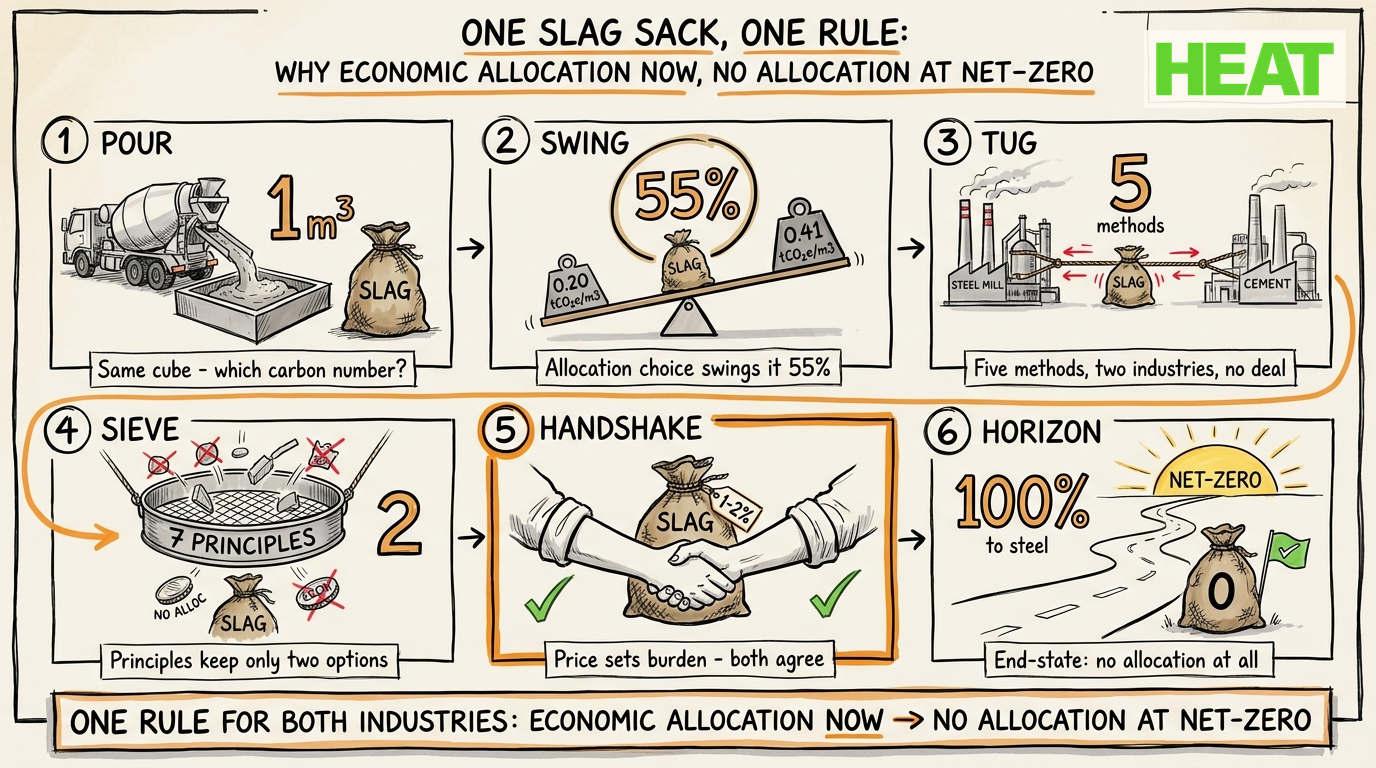
The story in six scenes: the same cube of concrete, five allocation methods, two industries — and the one deal that works.
① The swing on concrete
Same cubic metre, same plant, same day — only the slag allocation method changes. Reported GWP moves from 0.20 to 0.41 tCO₂e/m³: a swing of up to 55% between the extremes.
tCO₂e per m³ of concrete by allocation method (White Paper, Exhibit 1.6). Mirror image for steel: crude steel moves 2.33 → 1.83 tCO₂e/t across the same five methods. A buyer comparing two EPDs may just be comparing two accounting choices.
② The deal between steel and cement
The symmetry rule (Guidance 2.7) is what makes this a negotiation: whatever burden steel allocates away to slag, cement must inherit with the slag — nothing may be deleted at system level. Each industry pulls in the opposite direction; economic allocation is the point where both can let go of the rope.
- Slag earns only ~1–2% of revenue → steel keeps ≈ the full burden it already reports under no-allocation; barely any change to today's EPDs
- Ends the fight over system expansion (disallowed by EN 15804 / ISO 21930 anyway, despite being worldsteel's LCI method)
- One consistent story to automotive & construction buyers
- Gives up the big slag credit system expansion would grant (≈2.33 → 2.10 tCO₂e/t crude steel)
- Steel-price cycles nudge the split → needs reference prices / long-term averages
- Slag (GGBS) arrives nearly burden-free — priced at its tiny revenue share — so clinker substitution stays the strongest decarb lever
- Already common practice in the EU cement industry → low switching cost
- Kills mass-based allocation (0.41!) which would wreck the low-carbon-cement business case
- Accepts a small burden vs. today's no-allocation practice outside the EU (0.20 → 0.22)
- Depends on transparent slag price data — currently opaque and regional
Zoom-in: five methods → the sieve → the deal, in one chart
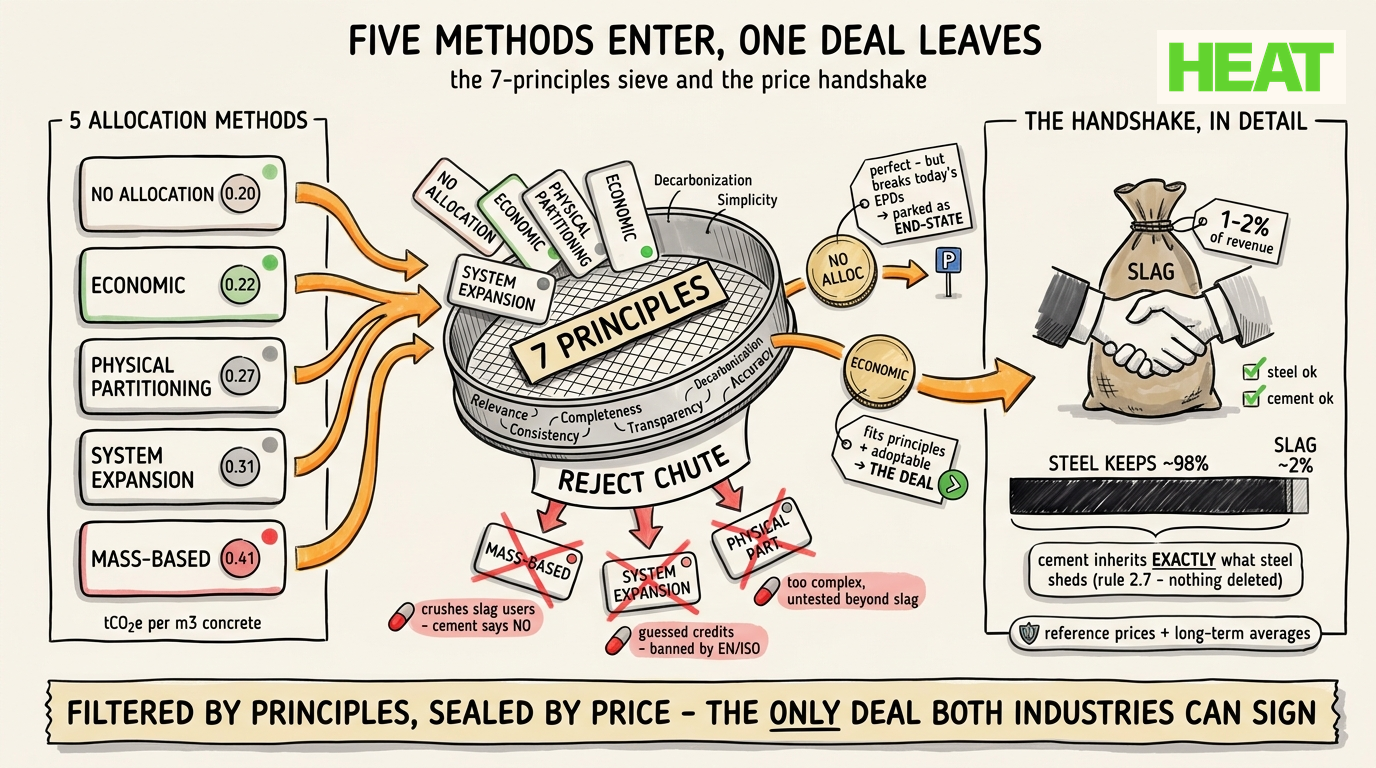
What gets filtered out and why: mass-based crushes slag users (cement says no) · system expansion relies on guessed credits and is banned by EN/ISO PCRs · physical partitioning is too complex and untested beyond slag. Survivors: no allocation (parked as end-state) and economic allocation (the deal) — sealed by the 98/2 price split, the rule-2.7 symmetry, and reference-price guardrails.
③ Economic allocation — the ledger
Why it works (+)
- Relevance: revenue is why the blast furnace runs — allocation mirrors real decision-making (GHGP principle)
- Passes all seven IDDI principles (GHGP ×5 + IEA ×2)
- Adoption-feasible: accepted by the cement industry, major steel players and global organisations
- No emissions deleted: steel's allocation = cement's inherited burden
- Waste co-outputs get nothing — consistent with how every method already treats zero-value outputs
What must be managed (–)
- Slag price data is opaque and varies by region → needs published reference data
- Cyclical steel prices shift the split → fix with long-term price averages
- If slag scarcity raises its value long-term, baselines drift — at 1–2% revenue share the effect stays trivial, but the guardrail must be written down
- Needs one common application guide, or "economic allocation" fragments into local variants
④ Why "no allocation" is the end-state — not the starting point
End-state logic (+)
- Satisfies all seven principles; the IEA names it the right approach in a net-zero world
- Simplest possible rule: steel carries 100%, slag carries 0 — nothing to game, trivially explained to any buyer
- Most conservative: no product ever looks greener through bookkeeping
- As all sectors decarbonize, the burden being shuffled shrinks toward zero anyway — the two rules converge
Why not today (–)
- Allocation is embedded in today's EN/ISO PCRs and in the majority of published steel EPDs — flipping now breaks continuity of thousands of declarations
- EU cement practice (economic allocation) would also have to move
- Slag would arrive at cement with zero burden by rule, not by price — removes the market signal on slag value
- Forcing it now risks a standoff; a transition rule gets both industries onto one method first
⑤ And who checks the checkmark?
A harmonized rule is only as strong as its verification. Guidance 1.1 asks PCRs for a self-declared "statement declaring alignment" — with zero checking mechanism behind it. Any PCR can stamp itself compliant. The fix comes in two steps: a WG2 self-check checklist now (cheap, immediate), and a real conformity assessment inside the ISO Technical Specification (durable, enforceable).
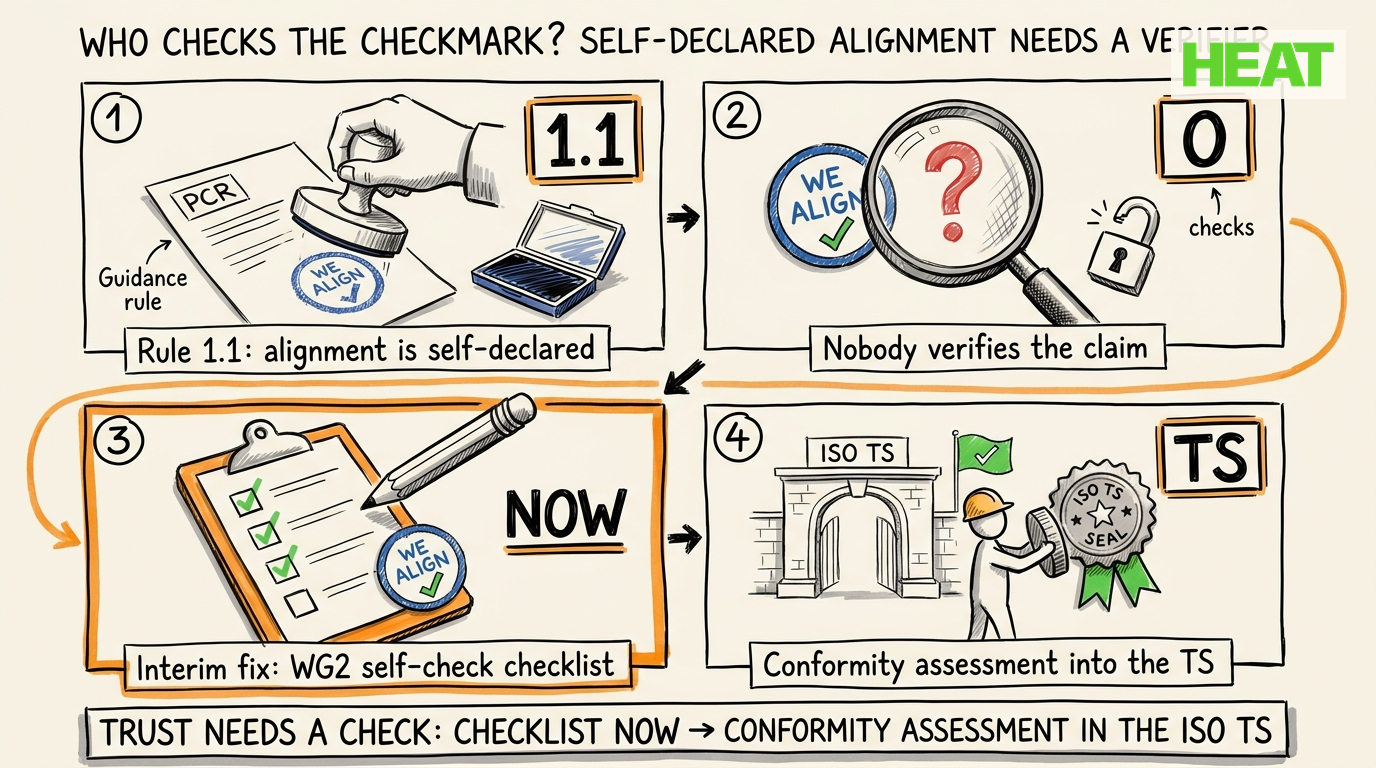
The alignment badge's journey: self-inked → hollow under the magnifier → ticked against a checklist → properly sealed at the ISO TS gate.
⑥ The WG2 self-check — what's actually on the clipboard
Ten ticks, straight out of Guidance v1.0, grouped in three families. The rule of use: 10/10 with one line of evidence each = the PCR may carry the alignment statement; anything less must say "partially aligned" and name the open items. Items 9 and 10 — machine-readable EPDs and RAND licensing — are the empirically weakest, so the gate bar holds the badge back until they are closed.
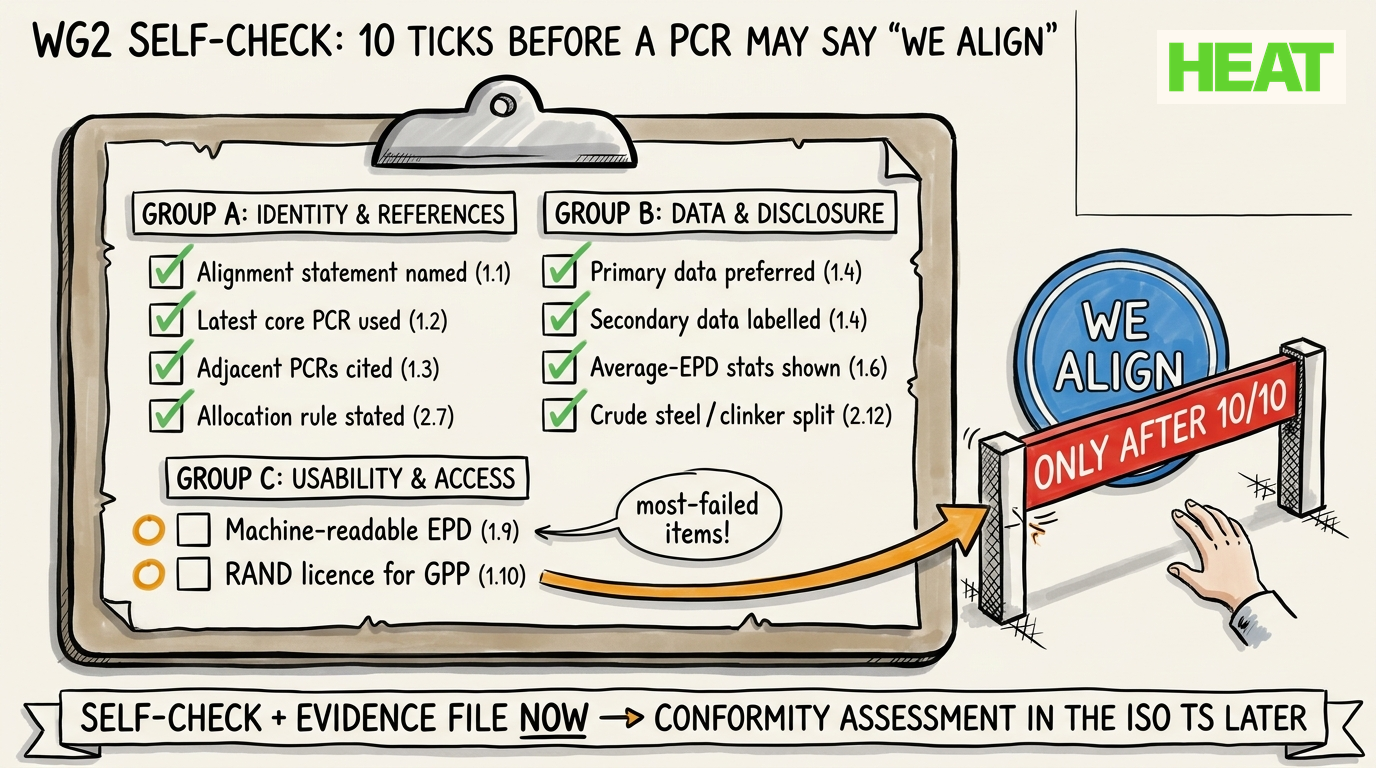
Checklist v0 for WG2 discussion. Group A: identity & references (rules 1.1, 1.2, 1.3, 2.7) · Group B: data & disclosure (1.4, 1.6, 2.12) · Group C: usability & access (1.9/2.14, 1.10). Sunset clause: retires when the ISO TS conformity assessment enters into force.
Why a checklist works now (+)
- Zero new institutions — the PCR committee ticks, the program operator attests under rule 1.8
- Turns a hollow claim into ten falsifiable statements with a one-page evidence file
- Feeds the landscape study: the same ten items double as coding indicators
- Creates the paper trail the ISO TS conformity assessment will later formalize
Its honest limits (–)
- Still self-assessment — a determined greenwasher can tick boxes; only the TS brings independent checking
- Needs WG2 endorsement and a template, or ten variants will bloom
- Items 9 & 10 depend on third parties (EPD platforms, standards bodies' licensing) — a PCR can be blocked through no fault of its own
⑦ Gap report: what 2026 adds to the 2024 corpus — and what is still missing
The 2024 corpus (White Paper Dec 2023 + Guidance v1.0 Apr 2024) drew the blueprint: seven issues, seven principles, a technical grid, and a dated work programme. 2026 has expanded the evidence (42-document landscape study), the institutional pathway (ISO TS via TC207/SC5, DIN secretariat interest), the verification scaffolding (self-check + register) and the usability lens. But none of the substantive 2024-dated decisions has been closed.
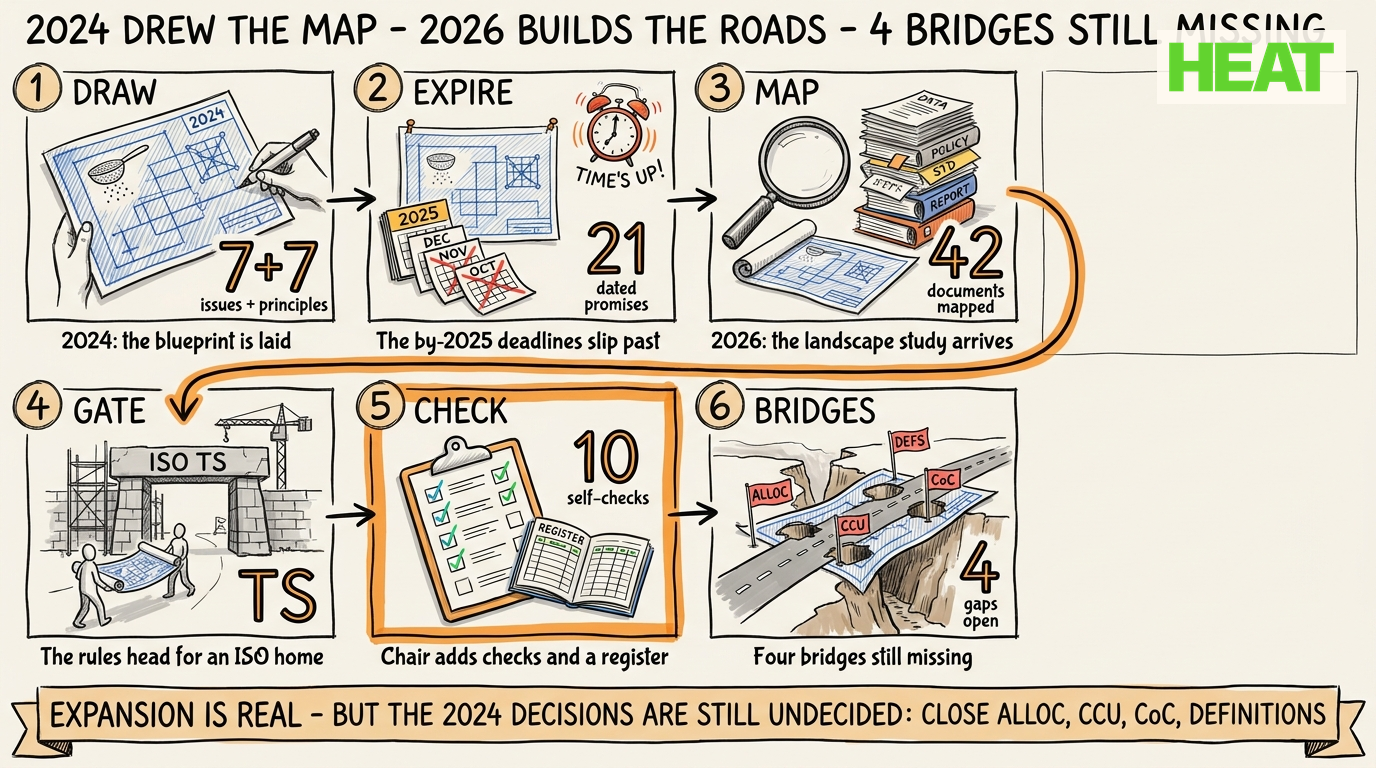
The blueprint's journey 2024 → 2026: drawn → deadlines expire (~21 dated promises) → 42-document study → ISO TS gate → chair's checks & register → four bridges still missing.
Where 2026 expands 2024 (+)
- Evidence: desk study → systematic 42-document map + structured interviews (public + private reports)
- Institution: "propose revisions via TCs" → concrete ISO TS route, SC5 chair supportive, DIN secretariat interest
- Verification: bare self-declaration → 10-item self-check + evidence file + operator attestation
- Governance: dated promises → obligations register with owners and destinations
- Scope: construction materials → extension debate (hydrogen, methanol, SAFs)
The four missing bridges (–)
- ALLOC: single allocation method — due 2025, still open; the 55 % swing persists until decided
- CCU: accounting philosophy (system-estimate vs full abatement, storage duration) — workstream promised 2024, no position
- CoC: mass balance / book & claim permissibility — working group promised 2024, certificates racing ahead
- DEFS: low/near-zero definitions — study and TS may each assume the other closes it
- Plus six second-order gaps (primary-data metric, carbonation thresholds, prEN 17662 status, open database, data refresh, non-construction steel) — see the full gap report
Downloads: WG2 Self-Check deck (PPTX, one slide per check) · full gap report in the KB: Study-equilibria/2024-WhitePaper/GAP-REPORT_2024-corpus-vs-2026-workstreams.md
Sources: IDDI White Paper "Driving Consistency in the Greenhouse Gas Accounting System" (5 Dec 2023), §4.3 & Exhibits 1.3, 1.6, 1.7 · IDDI Guidance for PCR Harmonization v1.0 (Apr 2024), rules 1.1, 2.7, 2.12 · HEAT WG2 chair assessment 2026-08-08. Numbers are illustrative sensitivity ranges from the White Paper (2023 BCG analysis) — flag for refresh before external use. Internal working material — not an IDDI position.